Places
Stein am Rhein: Painted Houses, a Monastery and the Rhine Falls
Stein am Rhein is a small medieval town on the Rhine, at the western end of Lake Constance where the river flows out of the Untersee. It is best known for its painted façades, which the regional tourist board calls world-famous, and for a main square, the Rathausplatz, lined with half-timbered houses covered in murals. Above the town stands Hohenklingen Castle; beside the river, the monastery of Sankt Georgen, one of the best-preserved medieval monasteries in Switzerland.
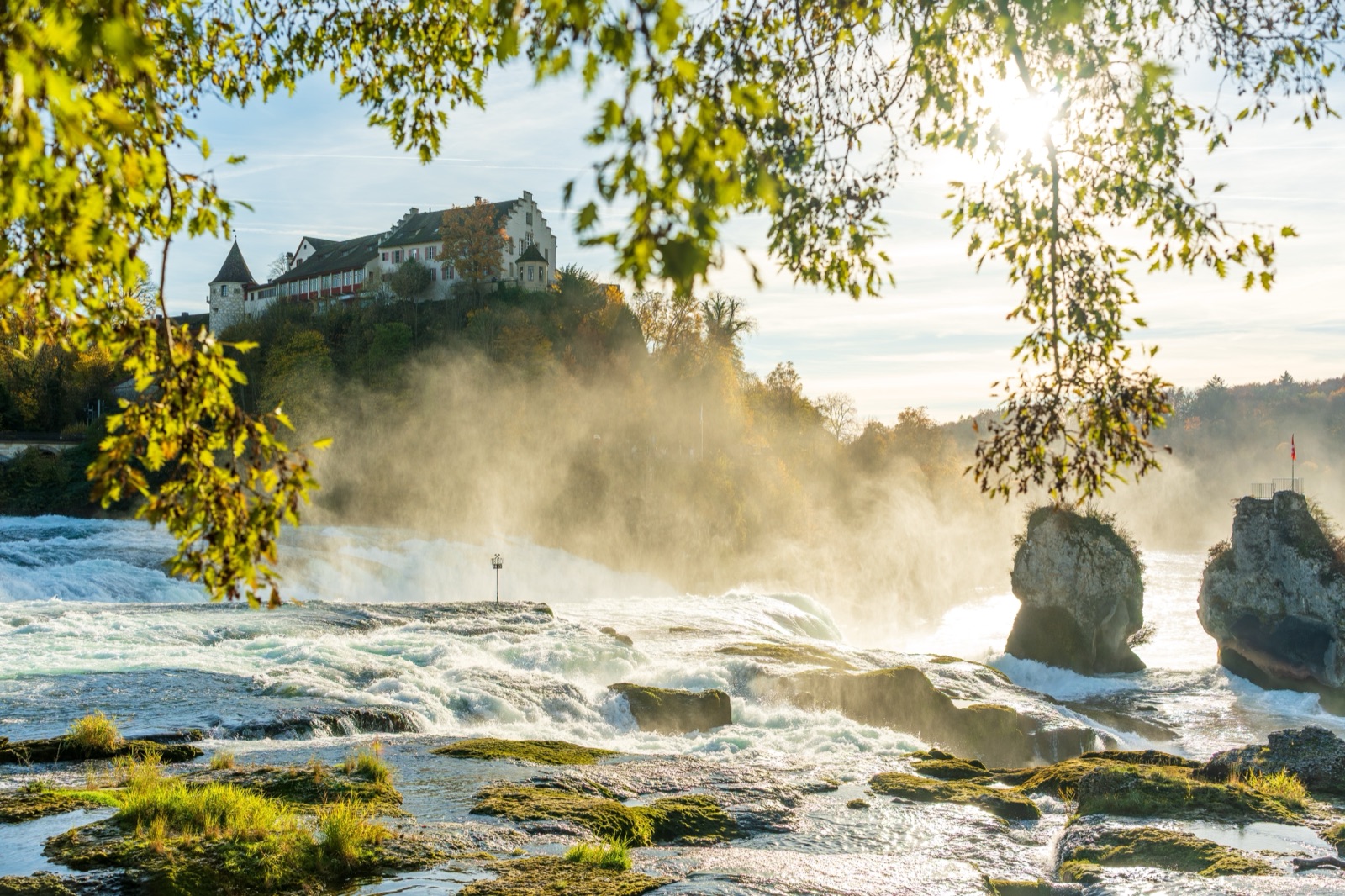
It is not next to the Rhine Falls. Stein am Rhein lies upstream of Schaffhausen, and the river stretch between the two towns alone is around 19 km; the falls are a little further downstream, beside Neuhausen. From the falls you reach Stein am Rhein by S-Bahn via Schaffhausen, or by the scheduled Rhine boats from Schaffhausen when they are running. In autumn 2026 low water has interrupted that boat route, so check before you plan around it.
Stein am Rhein at a glance
- Where: at the western end of Lake Constance, where the Rhine leaves the Untersee, in the canton of Schaffhausen.
- From Zurich: 56 km, which the regional tourist board puts at 1 h 10 min by train or 55 min by car.
- From Schaffhausen and the falls: S-Bahn from Schaffhausen; in season, the URh boats from Schaffhausen.
- Arriving by train: from the station it is a few steps over the Rhine bridge into the old town.
- Main sights: the Rathausplatz and its painted houses, the Sankt Georgen monastery museum, Hohenklingen Castle.
- Visitors: around a million a year, according to the canton, so expect company on the square.
A short history
People have been coming to Stein am Rhein for a long time. The canton’s visitor pages note that the Romans first set up a trading post here around the birth of Christ. What visitors come to see today is the medieval town: the painted houses around the square, the monastery on the water and the castle on the hill.
The town also has a claim in Swiss conservation history. The Swiss Heritage Society has awarded its Wakker Prize, for towns that look after their built heritage, since 1972, and its list of winners begins with Stein am Rhein. The society’s own account of that first award describes the town as a model example.
The Rathausplatz and the painted houses
The canton’s visitor pages put it neatly: you can spot visitors in Stein am Rhein by the way they stroll slowly with their heads tilted upwards. The painted façades run from the north-western Obertor gate down to the town hall, with motifs from the Middle Ages, the Baroque, the Renaissance and modern times.
Houses to look for
- Weisser Adler: on the Rathausplatz, with the oldest Renaissance façade painting in Switzerland.
- Adler: right next door, painted by the Swiss artist Alois Carigiet in 1956, almost 400 years later. Standing in front of the two together is the quickest lesson in how long this tradition has lasted.
- Rother Ochsen: the town’s oldest tavern, with a colourful façade, late-Gothic stepped windows and a stone oriel. The canton lists it as a favourite with photographers.
The town hall
The Rathaus closes the square. It was built between 1539 and 1542 and for a long time also served as a cloth, grain and trading hall. It took its present form between 1898 and 1900, when the open market hall was closed and the oriel and the paintings were added. The history paintings are by Carl von Häberlin of Stuttgart.
Inside, the Gothic great council chamber holds a famous collection of heraldic stained glass from 1542, and the town council has met in the small council chamber since 1542; that room was fitted with gilded Rococo panelling in 1766. The regional tourist board notes that the building and its collections cannot currently be visited, so for now the town hall is one to admire from outside.
The walls themselves tell the town’s stories. The best-known legend is “No e Wili” (“a little while yet”): in 1478, it is said, an alert baker’s apprentice held off night-time attackers from the Hegau with those words while they waited for a signal from a treacherous former mayor, and the town was saved from being absorbed by Austria. Huldrych Zwingli’s speech in Stein is depicted on the town hall’s east façade.
Kloster Sankt Georgen
Down by the river, the former Benedictine monastery of Sankt Georgen is the town’s most rewarding museum. According to the regional tourist board it was founded around 1007 by Emperor Henry II and dissolved in 1525 in the course of the Reformation. Unusually, the complex, with all the rooms that belonged to a Benedictine abbey, survived almost complete.
The museum is run as an institution of the Swiss Federal Office of Culture. The tour leads through the monks’ former rooms, the abbots’ houses and the monastery garden with its medicinal plants, and the panelling, carvings and wall paintings tell the story of the last monks in Stein am Rhein. The highlight is the banqueting hall, built around 1515 under the last abbot, David von Winkelsheim, which holds one of the most important early Renaissance fresco cycles north of the Alps. Film fans may recognise the setting: the feature film “Zwingli” was shot here in 2018.
Visiting Sankt Georgen
The museum’s own visitor page gives these details for the 2026 season:
| Season | 3 April to 1 November 2026 |
| Opening hours | Tuesday to Sunday, 12:00 to 17:00; closed Mondays |
| Adults | CHF 7 |
| Groups of 10 or more | CHF 5 each |
| Pensioners, students, guest-card holders | CHF 4 |
| Children and young people up to 16 | Free |
It is about a ten-minute walk from Stein am Rhein station and about five minutes on foot from the boat pier. Some third-party listings still show older opening times, starting earlier in the day; the museum’s own page is the one to follow, and the season closes from November to the end of March.
Hohenklingen Castle
Burg Hohenklingen stands high above the old town, with a wide view over the Hegau, Lake Constance and the Rhine landscape. Its history probably goes back to the eleventh century; it reached its present size in the thirteenth century, has belonged to the town of Stein am Rhein since 1457, and was carefully renovated between 2005 and 2007. Today it is a museum and a restaurant, and the castle itself can be visited free of charge, without eating at the restaurant, within its opening hours.
The canton describes the castle as 800 years old and recommends the walk up: the path runs flat at first between fields, then climbs through what it calls the finest vineyards far and wide. At the top the view takes in the old town, the Rhine and the Untersee.
Opening hours vary with the season. In the week of 28 September to 4 October 2026 the regional listing showed the castle closed on Monday and Tuesday and open from Wednesday, from 10:00; in the summer season (May to September) it is also open on Tuesdays, from 10:00 to 17:00. Check the listing before you walk up, particularly early in the week.
A walk through the old town
The old town is small enough to see on foot in an hour, and a loop gives some order to it:
- Start at the Rhine bridge. Arriving from the station, you cross the river and step straight into the old town.
- Sankt Georgen and the town church. Walk down to the monastery on the Fischmarkt, by the river; its neighbour, the Stadtkirche, is the former monastery church, dating from the twelfth century.
- The Rathausplatz. The heart of the town, with the town hall, the Weisser Adler and the Adler. The Haus zum Schwarzen Horn, directly on the square, is one of the finest historic buildings in the town.
- The Untertor. Follow the main street to the Untertor, one of the most impressive town gates in the region, with its tower and well-preserved walls.
- The Obertor. At the north-western end of the old town, the Obertor marks where the painted façades begin. Look out, too, for the Hexenturm, also called the thieves’ tower.
- Up to the castle. From the edge of the old town, the path climbs to Hohenklingen.
Two small museums
- KrippenWelt: in the oldest house in town still preserved in its original state (1302), with between three and five hundred nativity scenes from around the world in changing displays, and not only at Christmas.
- Museum Lindwurm: the Biedermeier period (about 1815–1848) brought to life on four floors, showing how a well-off family lived without electricity or running water.
Getting there
By train
Stein am Rhein is on the S-Bahn from Schaffhausen and Winterthur, and from Konstanz across the German border. From the station it is a few steps over the Rhine bridge into the old town.
- From the Rhine Falls: go back to Schaffhausen first, by the S-Bahn from Schloss Laufen am Rheinfall (S33) or Neuhausen Rheinfall (S9), or by bus no. 1 from Neuhausen Zentrum, then change for Stein am Rhein.
- From Zurich: 1 h 10 min by train, according to the regional tourist board, usually with a change in Winterthur or Schaffhausen.
Check the SBB journey planner for your date, as connections change with the timetable.
By car
Stein am Rhein is 56 km from Zurich, about 55 minutes by car. The regional tourist board points out that the train is often just as quick, without the search for a parking space in the old town. A toll sticker is required on Swiss motorways; the Rhine Falls boat operator notes it is sold near the border for CHF 40.00.
By boat on the Rhine
The most scenic way in is by water. The URh (Schifffahrtsgesellschaft Untersee und Rhein) runs scheduled boats from April to October between Schaffhausen and Konstanz/Kreuzlingen, calling at Stein am Rhein. Its own blog describes the full route, Kreuzlingen to Schaffhausen, as 50 kilometres with 17 stops on the Swiss and German banks.
The stretch between Stein am Rhein and Schaffhausen is the interesting one. It is around 19 kilometres of High Rhine, and its shallows are tricky enough to have names: Mörder, Wucherstein, Fahrkopf, Salzfresser and Apfelfresser. Near Diessenhofen the boats pass under a wooden bridge that is over 150 years old and links Switzerland with the German bank; at high water, boats cannot get under it at all. The regional tourist board is clear that the trip takes longer than the train or the car, which is rather the point. Tickets are sold on board, and there is a restaurant on all the scheduled boats.
Check the river before you go. The URh warns that sailings can be partly or completely cancelled in fog, storms, high water or low water, and autumn 2026 is a case in point. At the end of September 2026 its site reported:
- Low water on the Rhine has interrupted the route between Stein am Rhein and Diessenhofen, and the landing stages at Mammern, Wangen and Diessenhofen cannot be served.
- From Schaffhausen: four round trips a day until 4 October, plus a later departure on Thursdays; from 5 October until the end of the season on 18 October 2026, three departures a day on the “Rheinrunde”.
- Between Kreuzlingen/Konstanz and Stein am Rhein: 3 sailings a day until 4 October, with one more on Sundays, then one a day in each direction from 5 to 18 October. Stein am Rhein stays reachable by boat or, if needed, by replacement transport timed to the boats.
- Hop-on, hop-off: from 9 October to 8 November, a hop-on/hop-off boat runs on the Untersee on Fridays, Saturdays and Sundays.
In a normal summer the picture is very different: the summer timetable ran daily from 27 June to 13 September 2026, and the canton describes a dozen scheduled boats a day mooring right in front of the old town. Many passengers break the journey here to see the painted façades before sailing on.
Combining Stein am Rhein with the Rhine Falls
On a tour from Zurich
The Stein am Rhein and Rhine Falls tour from Zurich travels through wine villages to the falls at Schloss Laufen, then continues to the medieval old town of Stein am Rhein, in about 5 hours. It is the easiest way to see both without planning connections, although time in each place is limited. Our guide to Rhine Falls day trips from Zurich compares it with the other tours, and the tours page has live prices.
On your own: a day plan
- Morning: take the train to Schloss Laufen am Rheinfall and be there when ticketing opens at 09:00. Walk the platforms, then take the boat crossing (from CHF 6.00) or the rock trip (from CHF 22.50, including ferry no. 2). The boats and platforms guide explains the options.
- Late morning: bus no. 1 from Neuhausen Zentrum or the S-Bahn back to Schaffhausen, then the S-Bahn on to Stein am Rhein.
- Lunch: in the old town, then the Rathausplatz and the painted houses.
- Afternoon: Sankt Georgen, which opens at 12:00 and closes at 17:00, then the walk up to Hohenklingen if it is open that day.
- Evening: the train back to Zurich, about 1 h 10 min.
If the Rhine boats are running normally, you can reverse the order in summer: sail from Schaffhausen to Stein am Rhein in the morning, spend the middle of the day in town, and take the train back to the falls in the afternoon. The falls are open around the clock and illuminated after dark, so a late visit works well.
Avoid Mondays if the monastery matters to you: Sankt Georgen is closed, and in late September 2026 Hohenklingen was closed on Mondays too. Our Schaffhausen article covers the town in between, with the Munot fortress and Allerheiligen, if you would rather split the day three ways.
Tips for a good visit
- Go early. With around a million visitors a year, it pays to reach the Rathausplatz early in the day.
- Look up. The paintings cover the façades well above street level, from the Obertor all the way to the town hall.
- Do not plan on the town hall interior. It cannot currently be visited.
- Buy boat tickets on board. URh sells its tickets on the boats.
- Combine with the castle walk. The climb to Hohenklingen is the best view of the town and the river, and entry to the castle is free.
Frequently asked questions
How far is Stein am Rhein from the Rhine Falls?
Stein am Rhein is upstream of Schaffhausen, and the falls are just downstream of it, beside Neuhausen. The river stretch between Stein am Rhein and Schaffhausen alone is around 19 km. By public transport, go from the falls to Schaffhausen by S-Bahn or bus, then take the S-Bahn to Stein am Rhein.
Can I take a boat from Schaffhausen to Stein am Rhein?
Normally yes: URh boats run from April to October between Schaffhausen and Konstanz/Kreuzlingen, calling at Stein am Rhein. In autumn 2026, though, low water interrupted the route between Stein am Rhein and Diessenhofen, and the season ends on 18 October 2026. Check the URh site before you travel.
How long do I need in Stein am Rhein?
Two to three hours covers the Rathausplatz, the painted houses and the Sankt Georgen monastery museum. Add another hour or so for the walk up to Hohenklingen Castle and the view.
Can I visit the town hall in Stein am Rhein?
Not at the moment. The regional tourist board notes that the building and its collections, including the heraldic glass from 1542, cannot currently be visited. The painted exterior is the main attraction anyway.
When is the Sankt Georgen monastery museum open?
In 2026, from 3 April to 1 November, Tuesday to Sunday, 12:00 to 17:00. Adults pay CHF 7, and children and young people up to 16 go free.
Is there a tour that combines Stein am Rhein and the Rhine Falls?
Yes. A tour from Zurich travels through wine villages to the falls at Schloss Laufen and then to the old town of Stein am Rhein, in about 5 hours.