Places
Schaffhausen: Old Town, Munot Fortress and the Rhine Falls Next Door
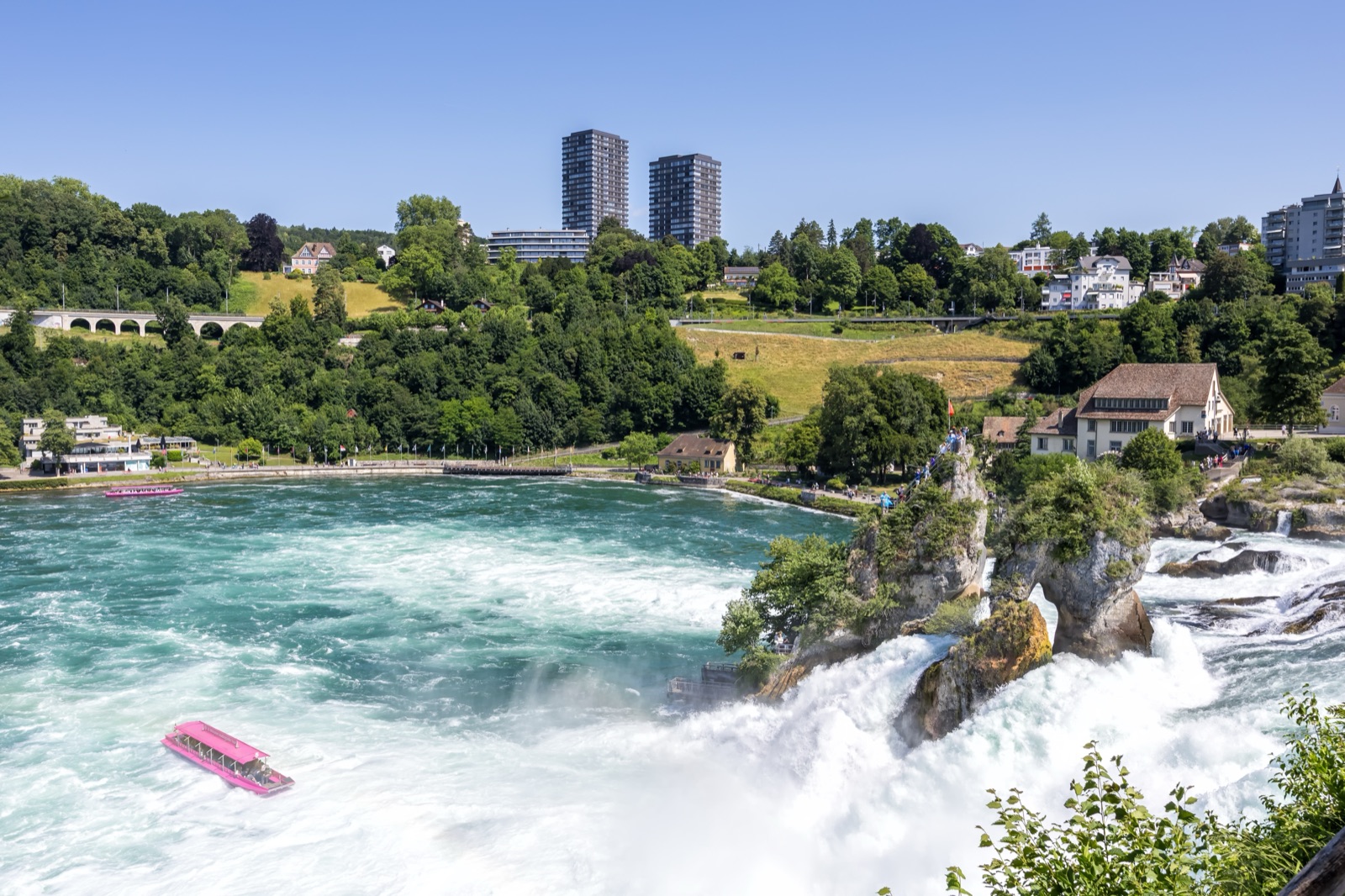
Schaffhausen is the town next to the Rhine Falls. The falls themselves lie on the edge of Neuhausen am Rheinfall, the neighbouring municipality downstream, and Schaffhausen’s old town is a short bus or train ride away. There is no boat between the two: the falls’ own visitor site, rheinfall.ch, says plainly that no boats sail between Schaffhausen and the Rhine Falls, and points visitors to the bus, the train, the walking paths or a little road train instead.
If you are coming for the falls, the town is the natural second half of the day. It has three things worth the detour: an old town whose townhouses carry 171 ornate oriel windows, the round Munot fortress on the hill above the river, and the former Allerheiligen monastery, now one of Switzerland’s broadest museums. Schaffhausen sits in the far north of the country, directly on the German border, and about 40 minutes from Zurich by train.
Schaffhausen at a glance
- Where: the north of Switzerland, directly on the border with Germany.
- From Zurich: 50 km, which the regional tourist board puts at 40 minutes by train or 45 minutes by car. From Zurich Airport it is 49 minutes by train.
- To the falls: bus no. 1 or the S-Bahn to Neuhausen; no boats.
- The main sights: the old town with its oriels and painted façades, the Munot, and the Allerheiligen monastery with its cloister and museum.
- Time needed: half a day for the town on its own, a full day if you add the falls.
Our guide to getting to the Rhine Falls covers the two banks of the falls, prices and boats in detail; this article is about the town and how to fit the two together.
Why the falls shaped the town
One detail in the old town explains a good deal about Schaffhausen. The Fronwagturm, a tower on the Fronwagplatz, once held the great market scales. According to the regional tourist board, those scales weighed the goods that were unloaded from ships at Schaffhausen and then loaded onto ships again below the Rhine Falls.
In other words, the falls stopped river traffic, and cargo coming down the Rhine had to leave the water here and travel round them by land. The scales themselves are now in the Museum zu Allerheiligen, so you can see the tower in the morning and the machinery that went with it in the afternoon.
The old town: oriels and painted façades
The regional tourist board sums up Schaffhausen’s appeal as the combination of medieval façades, 171 ornate oriel windows (Erker, in German) and winding lanes. The oriels are the thing to look for: ornate bay windows projecting from the fronts of the townhouses, often one above another. Walk slowly and look up.
Haus zum Ritter
The most important single house is the Haus zum Ritter on Vordergasse. It is one of three painted houses still surviving in Schaffhausen; there were once about ten, and a painted façade was a sign of wealth. The regional tourist board describes its paintings as the most important Renaissance frescoes north of the Alps.
The history is layered. The house was rebuilt in 1566 by the knight Hans von Waldkirch, who had the façade painted by the Schaffhausen painter Tobias Stimmer in 1568/70. What you see today is not Stimmer’s original paint: the frescoes were recreated in 1938/39 and 1943 by Carl Roesch of Diessenhofen. Look closely at the two halves of the front, too. It was originally two houses, which is why the windows are uneven.
The Fronwagturm clock
Back on the Fronwagplatz, the gable of the Fronwagturm carries an astronomical clock by Joachim Habrecht. It shows ten different indications, among them the hours, the days of the week and the moon’s course through the signs of the zodiac, as well as eclipses and the aspects between sun and moon. It is worth a few minutes with the tourist board’s description in hand, working out which dial shows what.
Squares and fountains
- Fronwagplatz: the old market square, with the clock tower. At its southern end stands the Landsknecht fountain, also called the Metzger fountain, the largest fountain in the town.
- Herrenacker: the largest square in Schaffhausen, a short walk away.
The Munot: the fortress on the hill
The Munot is the round fortress on the Emmersberg above the old town and the symbol of Schaffhausen. The regional tourist board notes that it has stood above the town for over 400 years, and that it was built in the sixteenth century by the citizens themselves, as compulsory labour.
How it was built
The Munot association’s own history pages describe 25 years of construction, during which the design changed several times; the fortress was completed in 1589. Inside, the main room is the casemate, covered by a massive vault that rests on nine pillars and is approximately 6 metres thick, meant to protect the city against exploding shells and incendiary grenades. The casemate has six embrasures, a well and a latrine.
From the casemate a spiral ramp inside the round tower, a so-called equestrian staircase, climbs to the platform on top (the Munotzinne). It is a ramp rather than a staircase, and the view from the top reaches far over the roofs of the old town.
Two myths are worth dropping. The first is that the Munot was built to plans by Albrecht Dürer; the association says that theory, which still appears in some publications, is now considered obsolete. The second is that it was a formidable fortress. The association is candid that it would have been difficult to defend against an attack and would not have offered much protection to the city.
Decline and rescue
In the nineteenth century the Munot lost its defensive use, was left to decay, and at times was even used as a quarry. Thanks to Johann Jakob Beck (1786–1868), the decaying fortress was restored from 1835 onwards, and Beck founded the Munot Association in 1839. The association still looks after the building and fills its summer with events; the quadrille has been danced at the Munot Ball every year since 1886.
The nine o’clock bell
The small bell in the tower is the Munot’s best-loved tradition. It was cast in 1589 in the workshop of Hans Frei of Kempten and served as an alarm bell, warning the population of fire or enemy attack. It is around 70 cm high and weighs 420 kilograms.
Every evening at 21:00 the Munot warden, who lives in the tower, rings it by hand for five minutes. It was once the signal to close the city gates and the inns. In summer the fortress closes an hour before the bell, so you will usually hear it from the old town or the riverbank rather than from the platform.
Visiting the Munot
- Opening hours: May to September 8:00 to 20:00; October to April 9:00 to 17:00.
- On foot: only a few minutes’ walk from the town centre or the station.
- By bus: line 4 to the Künzleheim stop, from where the fortress is quickly reached.
- The scenic way: bus line 8 to Schifflände, then up the Munotstieg past Blauburgunder and Pinot Gris vines, about 10 minutes on foot.
- Next door: a rose garden of about 2,000 square metres with around 170 kinds of rose.
Check the association’s site before you go, because the platform is also used for private and public events in summer.
Allerheiligen: monastery, cloister and museum
The other big sight is the former Benedictine monastery of Allerheiligen (All Saints), right in the old town. The Historical Dictionary of Switzerland gives the outline: it was founded by Count Eberhard von Nellenburg as a proprietary monastery in what was then a rising market town, around 1050. In 1049 Pope Leo IX consecrated its Resurrection altar. The monastery was turned into a provostry in 1524 and dissolved in 1529, after the Reformation was introduced.
The Münster and the cloister
The church, begun on a larger plan, was built after a change of design as the three-aisled basilica that still stands, and consecrated after 1105. The regional tourist board calls the Münster the most original Romanesque church building in Switzerland.
Beside it is the cloister, the largest in Switzerland. It dates from the twelfth and thirteenth centuries and mixes Romanesque and Gothic elements. The garden in the middle, known as the Junkerfriedhof, was the burial ground for leading Schaffhausen figures between 1582 and 1874. Next to it is a herb garden, laid out in 1937/38 where the monks’ own herb garden once stood.
The Museum zu Allerheiligen
The monastery buildings now house the Museum zu Allerheiligen, which the regional tourist board calls the most varied universal museum in Switzerland. It covers archaeology, the history of the town and its industry, natural history and art. The art collection runs from the fifteenth century to contemporary work, with pieces by Cranach, Hodler, Vallotton, Otto Dix and Adolf Dietrich, and the Ebnöther collection is, in the museum’s words, one of the most important collections of antiquities in Europe. Look out for the Fronwag scales from the tower on the market square.
Practical details from the museum’s own site, current in September 2026:
| Opening hours | Tuesday to Sunday, 11:00 to 17:00; until 20:00 on the last Thursday of the month; closed Mondays |
| Adults (from age 20) | CHF 12; reduced CHF 9 |
| Under 20 | Free |
| Swiss Travel Pass holders | Free |
| First Saturday of the month | Free for everyone |
| Ticket including the special exhibition | CHF 15 for adults |
The museum is a 10-minute walk from the SBB station and from the boat landing on the Rhine. Prices and exhibitions change, so check before you go.
One small link to the wider region: the name of the Black Forest lake Titisee first appears, as “Titinsee”, in a document of this monastery from 1050. Our article on the Black Forest from the Rhine Falls picks up that thread.
Getting between Schaffhausen and the Rhine Falls
The falls are close, but not walkable in a few minutes, and there is no boat service between the town and the falls. The falls’ own site lists the alternatives: the Rhyfall Express, the walking paths, and the train or bus.
By bus
- Bus no. 1 (direction Herbstäcker / Rheinfall) runs from Schaffhausen station to the Neuhausen Zentrum stop. From there it is about 10 minutes on foot to the free basin at Schlössli Wörth on the north bank.
- Bus line 6 (direction Neuhausen, Bahnhof SBB) also stops at Neuhausen Zentrum.
By S-Bahn
- S9 (direction Uster) stops at Neuhausen Rheinfall. The falls’ own site gives about 8 minutes on foot from there to the basin; the boat operator allows 15 minutes to its landing stage at Schlössli Wörth.
- S33 (direction Winterthur) stops at Schloss Laufen am Rheinfall, directly above the falls on the south bank, the paid side with the platforms.
Which stop you choose decides which bank you start on. The north bank is free; the south bank at Schloss Laufen costs CHF 5.00 for adults and has the platforms and the Historama. The boats, rock and platforms guide explains the difference, and the crossing between the banks (from CHF 6.00) lets you see both. Line numbers and timetables change with the Swiss timetable, so check the SBB journey planner for your date.
By road train or on foot
The Rhyfall Express is a nostalgic road train between Schaffhausen’s old town and the falls. The falls’ site also advertises a “Mittelalter-Express” programme that starts at 11:00 at the Rhyality immersive hall in Neuhausen and then takes the Rhyfall Express into Schaffhausen for a guided walk. The signposted walking paths are the third option if you have time and good shoes.
A day plan: the falls and the town
This plan starts in Schaffhausen, which suits anyone arriving from Zurich by train or staying overnight in the town.
- Morning: take the S33 from Schaffhausen to Schloss Laufen am Rheinfall and be there when ticketing opens at 09:00. Walk the panorama path and the platforms down to the Fischetz.
- Late morning: cross the river by boat (from CHF 6.00) to the north bank at Schlössli Wörth, or take the rock trip if it is running. Then walk up to Neuhausen Zentrum and catch bus no. 1 back into town.
- Lunch: in the old town, then the Fronwagplatz, the clock and the Haus zum Ritter.
- Early afternoon: Allerheiligen, from 11:00 to 17:00 (not on Mondays): the Münster, the cloister and a couple of hours in the museum.
- Late afternoon: walk up to the Munot. In summer it stays open until 20:00, which leaves time for the view in the evening light; from October to April it closes at 17:00, so go earlier.
- Evening: dinner in the old town and the Munot bell at 21:00. If you still have energy, the falls are open around the clock and illuminated after dark, a short bus or train ride away.
If you arrive on a Monday, swap the museum for a longer walk: the Munot, the riverbank and the cloister garden. For a slower version over two days, our guide to Rhine Falls day trips from Zurich has a two-day plan that adds Stein am Rhein, and our article on Stein am Rhein covers that town and the Rhine boats in detail.
Seeing Schaffhausen on a tour
Most tours from Zurich are built around the falls rather than the town. The guided tour from Zurich with entry tickets travels by coach through the villages and vineyards of northern Switzerland, with a guide and entry tickets included, in about 4 hours. It is a tidy way to see the falls, but check the itinerary if time in Schaffhausen’s old town matters to you.
If you are already staying in Schaffhausen, the full listing of Rhine Falls tours and tickets shows products departing from both Zurich and Schaffhausen, with live prices and availability. The tours page collects them.
Practical tips
- Mondays: the Museum zu Allerheiligen is closed. The Munot, the old town and the falls are not affected.
- Free museum entry: under-20s, Swiss Travel Pass holders, and everyone on the first Saturday of the month.
- Winter hours: from October to April the Munot closes at 17:00.
- Driving: a toll sticker is needed on Swiss motorways; the boat operator notes it is sold near the border for CHF 40.00. In town, the train is often just as quick as the car.
- Wet paths: the falls mean spray, and steep paths get slippery after rain; wear shoes with a good grip.
Frequently asked questions
How far is Schaffhausen from the Rhine Falls?
The falls are on the edge of Neuhausen am Rheinfall, next to Schaffhausen. Bus no. 1 runs from Schaffhausen station to Neuhausen Zentrum, about 10 minutes on foot from the falls, and the S-Bahn stops at Neuhausen Rheinfall (S9) and Schloss Laufen am Rheinfall (S33).
Can I take a boat from Schaffhausen to the Rhine Falls?
No. The site that runs the falls says there is no boat service between Schaffhausen and the Rhine Falls. The alternatives are the bus, the train, the walking paths or the Rhyfall Express road train. Scheduled boats do sail upstream from Schaffhausen towards Stein am Rhein between April and October, although low water cut that route in autumn 2026.
How do I get to Schaffhausen from Zurich?
By train it takes about 40 minutes, according to the regional tourist board; by car, 50 km and about 45 minutes. From Zurich Airport the train takes 49 minutes.
When is the Munot open?
From May to September, 8:00 to 20:00; from October to April, 9:00 to 17:00. The warden rings the Munot bell by hand every evening at 21:00 for five minutes, which you can hear from the old town.
Is the Museum zu Allerheiligen worth it?
If you like history or art, yes: it combines the monastery, the largest cloister in Switzerland and a collection that runs from archaeology to Cranach, Hodler and Otto Dix. It is open Tuesday to Sunday, 11:00 to 17:00, and adults pay CHF 12, with free entry for under-20s and Swiss Travel Pass holders.
Can I see Schaffhausen and the Rhine Falls in one day?
Yes. The town and the falls are a short bus or train ride apart, so a morning at the falls and an afternoon in the old town, with the Munot at the end of the day, fits comfortably into one day from Zurich.