Places
Black Forest from the Rhine Falls: Titisee, Triberg and the Border
The Black Forest begins just across the German border from Schaffhausen, the town beside the Rhine Falls. Its best-known lake, Titisee, is under an hour’s drive away: ViaMichelin’s route planner gives 54 minutes on the fastest route from Schaffhausen to Titisee-Neustadt. That is why one day can take in both.
Two things are worth knowing before you go. The Triberg waterfalls, Germany’s highest, and the giant cuckoo clocks of Triberg are further north, in the central Black Forest, and make a separate, longer day. And the trip crosses a national border: both countries are in the Schengen area, but Germany has been checking its borders since September 2024, and Switzerland applies customs rules to anything you buy, so carry your passport and keep your receipts.
The Black Forest from the falls at a glance
- Titisee: 54 minutes by car from Schaffhausen to Titisee-Neustadt on ViaMichelin’s fastest route; Hochschwarzwald Tourismus puts Zurich and Basel airports about 1 hour’s drive from its region.
- Triberg: the waterfalls and the big cuckoo clocks, in the central Black Forest; a separate, longer day.
- Border: carry a passport; Germany is running checks at its land borders.
- Shopping: coming back into Switzerland, goods worth more than 150 francs in total per person per day attract Swiss VAT.
How close is the Black Forest?
The falls sit on the northern edge of Switzerland, and Schaffhausen is directly on the German border. North and west of it rises the Black Forest; its southern, higher part around Titisee is marketed as the Hochschwarzwald. Hochschwarzwald Tourismus puts Zurich and Basel airports about 1 hour’s drive away, and ViaMichelin’s fastest route from Schaffhausen to Titisee-Neustadt, the municipality that includes the lake, is 54 minutes. Traffic, roadworks and winter weather can stretch both.
By car
From Schaffhausen the main roads run north into Germany. The B 27 links Schaffhausen with Stuttgart by way of Donaueschingen, where it meets the B 31 from Freiburg, and the B 31 towards Freiburg is the road Hochschwarzwald Tourismus gives for reaching its region from the east. A route planner may suggest quicker cross-country roads. If you are driving from Zurich, remember that Swiss motorways need a toll sticker; the Rhine Falls boat operator notes it is sold near the border for CHF 40.00.
By public transport
There is no single direct train. Titisee is on the Höllentalbahn, the Black Forest line that links Freiburg with Donaueschingen, so any rail route from Schaffhausen joins that line, with at least one change. Hochschwarzwald Tourismus also lists a long-distance bus line that runs Munich - Friedrichshafen - Titisee - Freiburg - Zurich, which links Zurich and Titisee directly; check the operator’s timetable. Use the Deutsche Bahn or SBB journey planner for your date.
If you stay overnight in the region, ask your host about the KONUS guest card, which Hochschwarzwald Tourismus describes as a free ticket for local public transport.
Crossing the border
Switzerland is not in the European Union, but it is in the Schengen area, together with 25 EU members, Norway, Iceland and Liechtenstein. In principle that means no passport checks between Switzerland and Germany.
In practice, Germany has been carrying out checks at all its borders since 16 September 2024. According to a tagesschau report dated 18 August 2026, the measure had been extended three times, most recently to 15 September 2026, and the interior ministry had notified a further six-month extension to mid-March 2027, which applies unless the European Commission objects. Be ready for a check when you cross.
- Carry your passport (or a national ID card, if your country issues one).
- Bring euros or a card. Germany uses the euro, not the Swiss franc.
- Keep your receipts for anything you buy; see the customs rules below.
Customs on the way back into Switzerland
Switzerland’s customs office sets a VAT-free allowance of 150 francs: travellers entering the country may bring in goods for private use or as gifts up to that total value without paying Swiss VAT. The rules are strict:
- The allowance can be used once per person per day, and it applies to children too.
- If the total value is more than 150 francs, VAT is due on the whole amount, not just the excess.
- Any single item worth more than 150 francs is always subject to VAT, however many people are travelling together.
- Swiss VAT is 8.1% at the standard rate.
This matters if you buy a cuckoo clock: any single item worth more than 150 francs is taxable. The customs office counts the value after deducting German VAT, if the German VAT is shown on the receipt, so keep the receipt and declare the clock when you cross. The customs office also has an app, QuickZoll, for declaring goods before you reach the border.
Titisee
Hochschwarzwald Tourismus calls Titisee probably the best-known and most popular destination in its region, and the lake is open to visitors around the clock. Expect company: up to 2 million visitors a year browse the shops and souvenir stores along the Seestraße, the lakeside promenade.
There is more to it than shopping:
- Boats: two operators run round trips on the lake from their jetties, and small boats can be hired to explore it on your own.
- The lake walk: a 7.4 km path circles the lake along the shore and climbs to a viewpoint above it. Allow a couple of hours at an easy pace, or walk part of it and turn back.
- The railway: the station is close to the lake, and there is coach parking.
A name with a Schaffhausen link
The village was called “Viertäler” until 1 May 1929, when it took the name of its lake. The lake’s name is much older, and it has a connection to the Rhine Falls end of this trip: the name “Titinsee” appears in a document of the Allerheiligen monastery in Schaffhausen from 1050, and a charter of 9 October 1095 calls it “Titunsee”. The regional tourist board suggests the name may go back to Roman times, though it presents that only as a guess. Our article on Schaffhausen covers the monastery, now the town’s museum.
The Höllentalbahn
If you have time, the railway through Titisee is an attraction in itself. The Höllentalbahn runs from Freiburg via Hinterzarten, Titisee, Neustadt, Rötenbach and Löffingen to Villingen, and Hochschwarzwald Tourismus describes it as Germany’s steepest railway: between Himmelreich and Hinterzarten it climbs 400 metres in 12 km. The most spectacular point is the Ravenna viaduct, the largest bridge in the Black Forest, above the Ravenna gorge. Construction began at the end of May 1882. The steep section was once worked with the help of a rack system, because the locomotives of the day could neither haul the whole train up the gradient nor hold it on the way down; modern locomotives have made that unnecessary, and the whole line has been electrified since 2019. From Titisee a branch, the 3-Seen-Bahn, continues to Schluchsee and Seebrugg.
Cuckoo clocks
The cuckoo clock is the Black Forest’s best-known symbol, and the history behind it is a story about cheap wood and clever selling. According to the Black Forest’s regional tourist board:
- The first Black Forest wooden clocks were probably made in the second half of the seventeenth century.
- They were cheap because they were made of wood: building metal clocks was a privilege of the guilds.
- Around 1840 there were about 1,000 clockmaking workshops with some 5,000 workers between St. Georgen and Lenzkirch, making about 600,000 wooden clocks a year.
- In the first half of the nineteenth century every third clock in the world came from the Black Forest, according to Johannes Graf of the German Clock Museum in Furtwangen.
- England was the biggest market: in the mid-nineteenth century more than 200 Black Forest clock dealers lived in London.
- In 1850 the first clockmaking school opened in Furtwangen.
Where to see them
- The German Clock Museum in Furtwangen shows over 1000 clocks and the whole story of the cuckoo clock.
- The German Clock Road (Deutsche Uhrenstraße) runs right across the Black Forest, linking the clockmaking towns.
- Triberg claims the world’s largest cuckoo clock, at the Eble Uhrenpark. It was built at a scale of 60:1 from an original cuckoo-clock movement and can be visited inside and out. Its largest wheel is 2.60 m across, the movement weighs 6 t, the pendulum is 8 m long, and it took 5 years to build.
- Schonach, next door, has what Triberg’s own town site calls “the first world’s largest cuckoo clock”, so the title is claimed twice.
- The world’s smallest mechanical cuckoo clock, just 13.5 cm high, is on show in the Schwarzwaldmuseum in Triberg.
If you buy one, remember the Swiss customs allowance above.
The Triberg waterfalls
Triberg’s other draw is water. The town’s own site calls them Germany’s highest waterfalls: the Gutach falls 163 m into the valley in seven stages. After snowmelt and heavy rain the volume is at its most impressive. Three signposted routes lead through the falls, the Naturweg, the Kulturweg and the Kaskadenweg, and the main entrance is an easy walk from the town centre.
Practical details from Triberg’s site, for 2026:
| Opening | Daily; summer opening from 2 April 2026 until about November, when winter sets in |
| In winter | Only from the main entrance to the first platform |
| Evening lighting | Until about 22:00 |
| Adults, summer 2026 | €9.00 (€8.50 with a local guest card) |
| Family ticket, summer 2026 | €20.00 |
| Adults, winter 2026 | €7.00 |
| Children under 6 | Free |
The ticket also gives free entry to Triberg-Land, the Schwarzwaldmuseum and the Triberg-Fantasy photo museum. Dogs on a lead are allowed, and wheelchair users can reach the first platform step-free on a level path from the Asklepios Klinik entrance.
Be realistic about distance. Triberg is in the central Black Forest, further north than Titisee. Seeing the Rhine Falls, Titisee and Triberg in one day makes for a very long day; for most visitors it is better to choose between Titisee and Triberg, or to stay a night in the Black Forest.
Titisee or Triberg?
If you only have time for one, the choice is fairly clear-cut.
- Choose Titisee for an easy half day: a lake walk, a boat, the shops on the Seestraße and a scenic railway, all close together.
- Choose Triberg if waterfalls and clocks are the point. After the Rhine Falls, 150 m wide but only 23 m high, the Triberg falls are the opposite: a drop of 163 m in seven stages, with a platform that lets you feel the spray. Add the giant cuckoo clock and the Schwarzwaldmuseum, which the waterfall ticket covers, and it fills a day.
The Black Forest in winter
The Black Forest is a year-round destination, but the details change. Titisee itself is accessible at any time, while the Triberg waterfalls switch to winter opening from about November: prices drop, and only the section from the main entrance to the first platform stays open. Roads over the hills can be snowy, so check conditions before you drive, and check that the tours and boats you want are running. The Rhine Falls are open around the clock all year, and illuminated after dark, which makes a short winter day easier to plan.
Triberg makes a point of its winter season: the falls can be visited every day in sun, rain, snow or ice, the open lower section is cleared and gritted, and the falls are floodlit every day from dusk.
What to bring
- Your passport, for the border.
- Euros, or a card that works in Germany.
- Receipts for anything you buy, for Swiss customs on the way back.
- Walking shoes for the lake path at Titisee or the waterfall routes at Triberg, which can be wet.
- A light waterproof for the spray at the Rhine Falls and at Triberg.
Tours from Zurich
The tours from Zurich stay on the Swiss side: the half-day tours of about 4 hours focus on the falls, so the Black Forest is a day to plan yourself. Our guide to Rhine Falls day trips from Zurich compares the options, the tours page lists them with live prices, and the full listing of Rhine Falls tours shows what is available on your dates.
A self-drive day
With a car you can shape the day yourself:
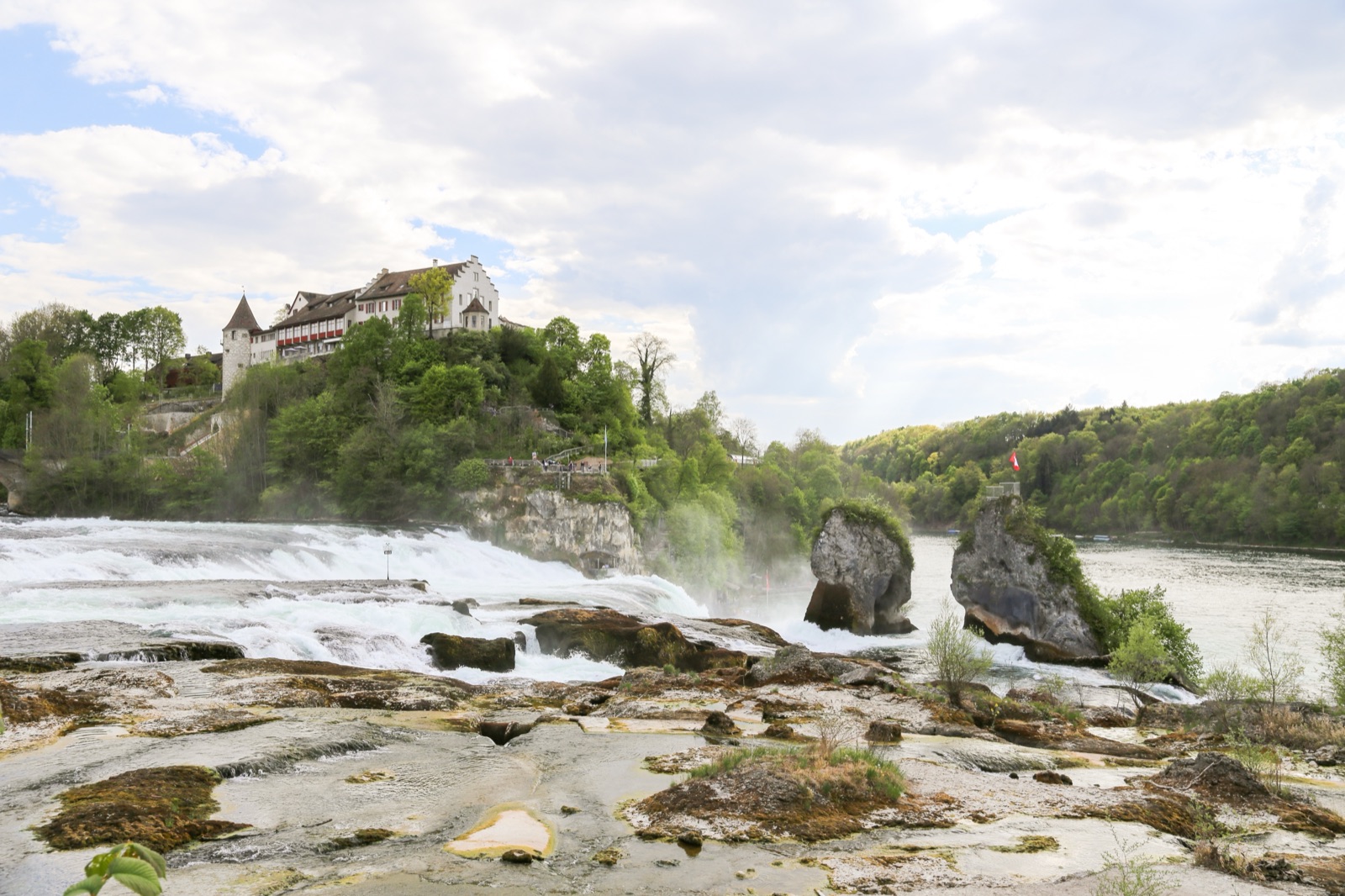
- Early morning: the Rhine Falls. The falls are accessible around the clock; Schloss Laufen’s ticketing opens at 09:00, and the north bank at Schlössli Wörth is free at any time. The getting to the Rhine Falls guide explains the two banks.
- Late morning: drive north into Germany, allowing about an hour to Titisee.
- Midday: Titisee. Walk part of the lake path, take a boat round the lake, or ride the Höllentalbahn for a few stops.
- Afternoon: either return towards Schaffhausen, or, if you started early and do not mind a long day, continue north to Triberg for the waterfalls, which are lit until about 22:00.
- On the way back: have your passport and receipts ready at the border.
Frequently asked questions
How far is the Black Forest from the Rhine Falls?
The Black Forest begins just across the German border from Schaffhausen, the town next to the falls. ViaMichelin’s fastest route from Schaffhausen to Titisee-Neustadt takes 54 minutes.
Do I need my passport to go to the Black Forest from Switzerland?
Yes, carry it. Both countries are in the Schengen area, but Germany has been checking at its borders since 16 September 2024, and a further extension to mid-March 2027 was notified in August 2026.
Can I bring a cuckoo clock back into Switzerland?
Yes, but declare it if it is worth more than 150 francs. Goods up to 150 francs per person per day are free of Swiss VAT; above that, VAT of 8.1% is due on the whole value, and any single item worth more than 150 francs is always taxable.
What is there to do at Titisee?
Walk the 7.4 km path around the lake, take a boat trip with one of the two operators or hire a small boat, browse the shops on the Seestraße, or ride the Höllentalbahn, Germany’s steepest railway, from the station by the lake.
When are the Triberg waterfalls open?
Every day. Summer opening in 2026 runs from 2 April until about November, and in winter only the section from the main entrance to the first platform is open. The falls are lit in the evening until about 22:00.