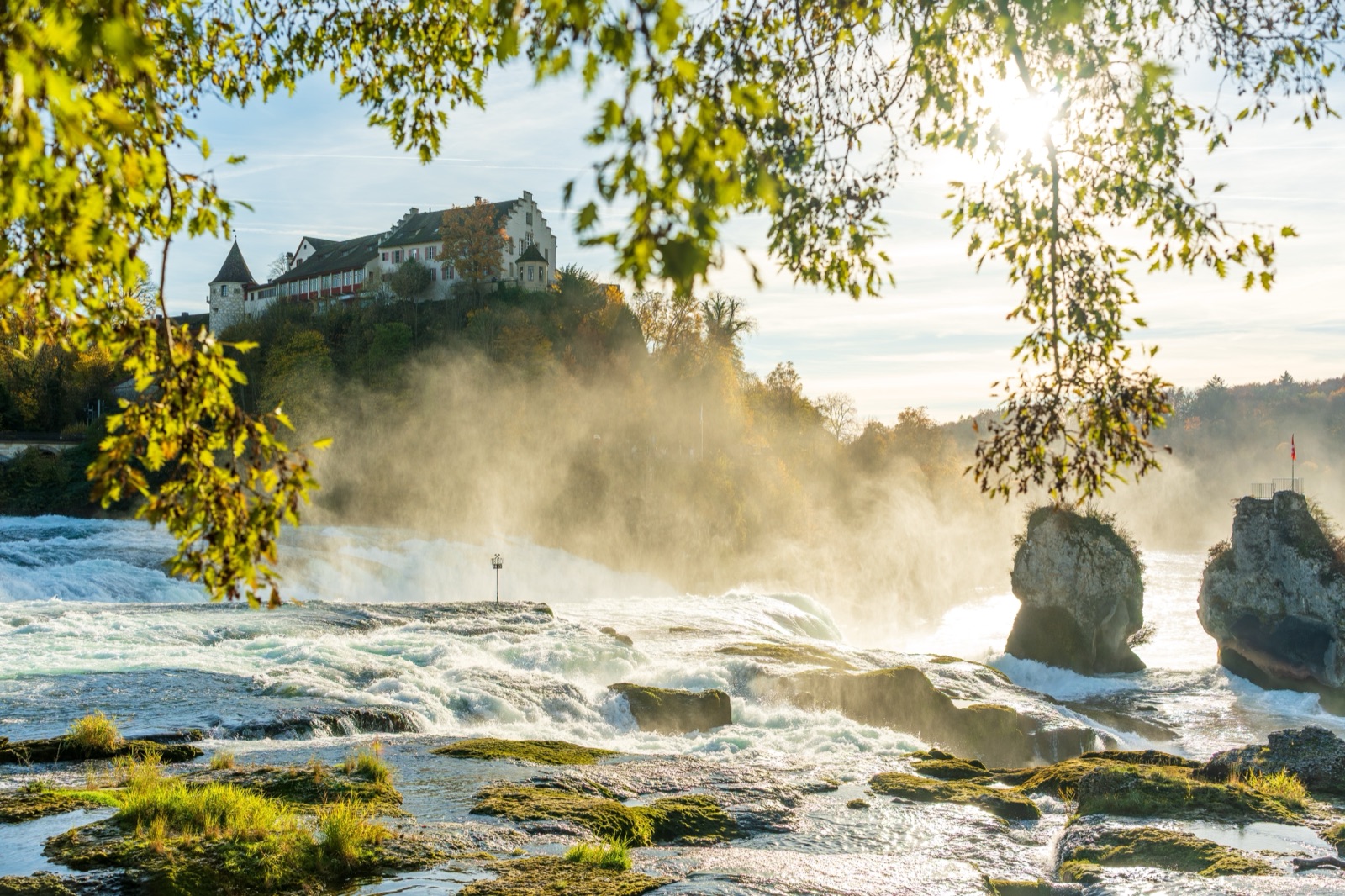
Best Time to Visit the Rhine Falls: Water Levels, Crowds and Seasons Month by Month
Rhine Falls weather this week
Rhine Falls (Schlössli Wörth) (361 m)
The five-day forecast for Rhine Falls (Schlössli Wörth), updated through the day.
Forecast data from MET Norway (CC BY 4.0), summarised by day.
The best time to visit the Rhine Falls is from May to September, and above all in June and July, when the Rhine carries the most water and every boat runs on its full summer timetable. If you want the falls at their most powerful with fewer people around them, aim for a weekday in June, arrive before 11:00, and leave the middle of the day to Schaffhausen or Stein am Rhein. April and October are a good compromise: less water, but quieter paths and the boats still running. Winter has its own appeal — the falls are open around the clock, 365 days a year, Schloss Laufen is lit up for the festive season, and you will have the viewpoints almost to yourself — but the boat programme shrinks to weekends and charters.
This guide goes through the year month by month: how much water goes over the falls, when the boats run, when the crowds peak, and what each season is like on the ground. For the forecast and the monthly temperatures and rainfall, see the Rhine Falls weather page.
The short answer
| If you want… | Go in… | Why |
|---|---|---|
| The falls at full power | June and July | The long-term mean flow peaks at 559 m³/s in June and 536 m³/s in July |
| Every boat trip running | May to September | The boats run 09:30 to 18:30 daily from 1 May to 30 September |
| Fewer people | April, October, or early mornings in summer | Peak hours are usually 11:00 to 16:00 at weekends, on holidays and in summer |
| The fireworks | 31 July | “Fire on the rocks” starts at about 21:45 — but check it is going ahead |
| Festive lights and no crowds | Mid-November to early January | Schloss Laufen’s Winterzauber runs from 13 November 2026 to 3 January 2027 |
How much water goes over the falls, month by month
The Rhine Falls are not a fixed spectacle. The amount of water changes a great deal through the year, and it is the single biggest difference between a visit in February and one in June.
The federal environment office, BAFU, measures the river at a station called Rhein – Neuhausen, Flurlingerbrücke, just above the falls. Its long-term monthly means, for 1959–2025, show the pattern clearly:
| Month | Mean flow (m³/s) | Mean water temperature (°C) |
|---|---|---|
| January | 257 | 4.9 |
| February | 255 | 4.4 |
| March | 264 | 5.7 |
| April | 315 | 9.2 |
| May | 433 | 13.3 |
| June | 559 | 18.1 |
| July | 536 | 21.0 |
| August | 459 | 21.7 |
| September | 398 | 19.2 |
| October | 335 | 15.0 |
| November | 288 | 10.8 |
| December | 275 | 7.0 |
The water temperatures are BAFU’s monthly means for 2009–2025.
One cubic metre is 1,000 litres, so a June mean of 559 m³/s is roughly 559,000 litres a second, against about 255,000 in February — more than twice as much water in early summer as in late winter. The long-term annual mean for the whole period is 365 m³/s.
You will often read that 700,000 litres a second pour over the falls. That is the regional tourist board’s headline figure, and on a high-water day the river carries that much and more. But it is not what you should expect on an average day: across the year, the river usually carries about half that.
Floods and dry years
The extremes are worth knowing about because they shape what you see:
- The record high. The highest flows ever measured at the station were 1,173 m³/s on 23 May 1999 and 1,159 m³/s on 11 June 1999. The highest annual mean was 507 m³/s, also in 1999.
- The record low. Daily means have fallen as low as 115 m³/s, on 5 February 1963.
- 2026, a dry year. BAFU’s table lists 2026 with the lowest annual mean in the record, 254 m³/s (counting the year so far, which is not over yet). Since 27 July 2026 BAFU has flagged its temperature readings at the station as heavily distorted by the low water level. Low water on the Rhine also interrupted the scheduled boats between Stein am Rhein and Diessenhofen.
A dry summer does not mean the falls are disappointing — they are still the largest waterfall in Europe by the tourist board’s description, and still loud enough to drown out conversation on the platforms. But in a dry year the falls look leaner, the rocks in the riverbed show more, and the spray is gentler. If seeing the falls at their most dramatic is the point of your trip, late May to early July is the safest bet.
The boat season
The boats in the basin — the rock trip to the middle rock, the round trips and the crossing between the two banks — are what most visitors remember, so their season matters as much as the water.
The boat operator publishes its season a year ahead. For 2026:
| Period | Daily hours |
|---|---|
| 28 February to 27 March | 10:30 to 16:00 |
| 28 March to 30 April | 10:30 to 17:00 |
| 1 May to 30 September | 09:30 to 18:30 |
| 1 to 18 October | 09:30 to 17:00 |
| 19 October to 1 November | 11:00 to 17:00 |
| 2 to 29 November | Weekends only, 11:00 to 16:00 (weekday charters on request) |
| From 30 November | Weekday charters on request only |
The operator’s company holidays run from 24 December to 3 January.
The 2027 season follows the same pattern: 27 February to 19 March from 10:30 to 16:00, 20 March to 30 April from 10:30 to 17:00, 1 May to 30 September from 09:30 to 18:30, 1 to 17 October from 09:30 to 17:00, 18 to 31 October from 11:00 to 17:00, and then weekends only from 1 to 28 November.
A few details change with the season:
- The audio tour runs daily only in June, July and August. The 30-minute audio round trip (line 5) leaves about every 45 minutes in those months; from 19 October 2026 it was no longer offered for the rest of the season.
- The rock trip goes to weekends in November. In 2026 it ran at weekends only from 2 to 29 November.
- The boats sail rain or shine. Only in persistent extreme weather are individual trips cancelled or postponed.
The boat operator itself calls April to October the best time to visit, when many of the most popular attractions are open and the weather is at its best. For prices and how each boat line works, see boats, the rock and the platforms.
Crowds: the busiest months and hours
The Rhine Falls are one of the busiest sights in northern Switzerland, and the crowds follow a predictable rhythm.
- The busiest hours. At weekends, on public holidays and throughout the summer season, the boats’ peak hours are usually between 11:00 and 16:00.
- The busiest months. In July and August the operator suggests arriving before 11:00 or after 16:00 for the best experience.
- Queues for the boats. Online tickets are booked for a set departure and let you board directly. The operator recommends buying ahead in high season and at peak times.
- Time on site. Allow at least one hour for a boat trip, more at busy times.
The good news is that the crowds are concentrated. The morning before 11:00 and the early evening are much calmer, even in August. Because the falls themselves never close, an evening visit on a summer weekend — when the day-trippers from Zurich have gone home — can be one of the best times of all.
Spring: March to May
Spring is when the falls wake up. The boats return at the end of February on short hours, and the water rises steadily from a mean of 264 m³/s in March to 433 m³/s in May.
- March. Still quiet, with the boats running 10:30 to 16:00 until late March. The water is cold — a mean of 5.7 °C — and the spray can feel icy on the rock trip.
- April. The boats run 10:30 to 17:00, the water is up to a mean of 315 m³/s, and Rhyality, the immersive art hall above the falls, starts its Saturday shows. A good month for a quiet visit with most things running.
- May. The full summer timetable starts on 1 May, with boats from 09:30 to 18:30. The flow jumps to a mean of 433 m³/s, and May holds the all-time record flood of 1999. A weekday in late May is one of the best combinations of water, open attractions and space.
What to wear: the boat operator suggests light jackets, jumpers, rain jackets and good shoes for spring and autumn.
Summer: June to August
Summer is the classic time to visit, and for good reason: the most water, the longest boat hours and the warmest weather.
- June. The peak of the year for water, with a mean of 559 m³/s. The audio tour begins its daily summer run. School trips fill the Adventure Park on weekdays in early summer, so it opens earlier on weekdays and closes its last entry at 15:30.
- July. Almost as much water as June — a mean of 536 m³/s — and the busiest month for visitors. The water warms to a mean of 21.0 °C. Arrive before 11:00.
- August. Still a mean of 459 m³/s, the warmest water of the year at 21.7 °C, and still busy. Late afternoon visits pay off.
In summer, the boat operator recommends good shoes, shorts, caps, sunglasses and sun cream — and a light jacket for the evening, because it is usually a few degrees cooler by the water. On the rock trip and the round trips, expect to get damp from the spray whatever the weather.
The 31 July fireworks
On the evening before Swiss National Day, the falls host one of the country’s most famous firework displays. “Fire on the rocks” starts after dark at about 21:45 on 31 July: the falls are lit in changing colours while fireworks and light effects play over the water. It is free to watch, and around 10,000 visitors are expected.
If you plan to go:
- Travel by train. The organisers recommend arriving early by public transport, on foot or by bike. Extra trains run before and after the display.
- Expect closures. Access to the basin via the Laufengasse and the lifts is closed from the Industrieplatz when crowds build, at the latest from 19:00.
- Parking is a flat fee. From 17:00 on 31 July all the Rhine Falls car parks on both banks charge a flat CHF 10 (CHF 50 for coaches). See the parking guide.
- Buses are diverted. From 22:00 the local buses are diverted and do not serve Neuhausen Zentrum.
Check before you travel. The fireworks depend on a permit from the canton. In 2026 they were cancelled: the canton of Schaffhausen refused the exception permit because of drought and forest-fire risk, and fireworks were banned across the canton on 1 August as well. The next display is listed for 31 July 2027.
Autumn: September to November
Autumn is the most underrated season at the Rhine Falls. The crowds thin after the summer holidays, the trees around Schloss Laufen turn colour, and there is still plenty of water.
- September. A mean flow of 398 m³/s, the full summer boat timetable until 30 September, and noticeably fewer people than in August. Arguably the best month for photographs and a relaxed visit.
- October. The boats run 09:30 to 17:00 until mid-October, then 11:00 to 17:00. The flow drops to a mean of 335 m³/s. The Adventure Park closes for the season at the start of November.
- November. Quiet, grey and atmospheric. The boats run at weekends only, the mean flow is 288 m³/s, and from mid-November Schloss Laufen’s winter lights go on.
Winter: December to February
Winter at the Rhine Falls is a very different visit — and for some people the best one.
- The falls never close. They are accessible around the clock, 365 days a year, and illuminated after dark. The Schloss Laufen viewing platforms are open around the clock too, and the castle’s ticketing and shop open 09:00 to 18:00 every day of the year.
- Winterzauber at Schloss Laufen. From 13 November 2026 to 3 January 2027 the castle is lit up with white lights and seasonal decorations, from about 16:00 to 01:00 Monday to Thursday, from about 14:00 on Fridays and Saturdays, and from about 12:00 on Sundays and every day from 24 December to 3 January.
- The winter lounge. On the terrace, a self-service lounge serves mulled wine, raclette and grilled sausages, on Saturdays 12:00 to 20:00 and Sundays 12:00 to 18:00, with drinks only on Fridays from 17:30 to 18:30, and every day from 21 December to 3 January. No reservation is needed.
- A medieval Christmas market. Schloss Laufen holds one from 20 to 22 November 2026.
- Fondue nights. Fondue chinoise is served on Fridays and Saturdays from 18:00 until 20 March 2027.
What you give up in winter is the boats: from the end of November only weekday charters on request are offered, and the operator closes from 24 December to early January. The water is also at its lowest — a mean of 255 m³/s in February — so the falls are at their least powerful. But on a cold, clear morning, with mist rising off the basin and nobody else on the paths, they are still spectacular.
Smilestones, the indoor miniature world beside the falls, makes a good winter add-on: from November to March it is closed on Mondays and Tuesdays and open from Wednesday to Sunday.
The best time of day
Whatever the month, the time of day makes a big difference.
- Early morning. The quietest time, and the light on the falls from the north bank is soft. The boats start at 09:30 in summer.
- Midday. The busiest time on summer weekends. Use it for lunch, Schaffhausen’s old town or a walk.
- Late afternoon. The crowds thin after 16:00, and the boats keep running until 18:30 from May to September.
- After dark. The falls are illuminated, and there is no one about. The paid facilities have their own hours, but the paths, the free north bank and the castle platforms are open.
Weather and what to bring
The falls lie at about 361 m in the basin, so the weather is that of the low country of northern Switzerland, not the Alps: mild summers, cold but rarely severe winters, and rain spread through the year. For the five-day forecast and the monthly averages for Schaffhausen, see the weather page.
Whatever the season:
- Bring a waterproof layer for the boats and the lower platforms — the spray reaches further than you expect.
- Wear shoes with grip. The paths and steps near the water are often wet.
- Pack a warm layer in spring and autumn, when the boats and the shaded paths on the south bank feel colder than the town.
When to go, by type of visit
- First visit, short on time: a weekday morning between May and September, with the rock trip.
- Photographs: September or early June, early or late in the day.
- Families: June or September, when the Adventure Park and all the boats are running but school holidays are not at their peak. See the guide to the Rhine Falls with kids.
- A combined day with Stein am Rhein: April to October, while the Rhine boats run between Schaffhausen and Lake Constance. See day trips from Zurich.
- Walkers: spring and autumn, when the riverside paths are cooler and quieter. See walks and hiking trails.
- Festive atmosphere: late November to early January, for the Winterzauber.
If you would rather not plan the timing yourself, the guided tours from Zurich choose the times and handle the tickets.
Frequently asked questions
What is the best month to visit the Rhine Falls?
June, for the most water — the long-term mean flow is 559 m³/s — together with the full boat programme. September is the best month for a quieter visit with plenty of water still going over.
When are the Rhine Falls least crowded?
Before 11:00 and after 16:00, on weekdays, and outside July and August. Winter is the quietest season of all.
Can you visit the Rhine Falls in winter?
Yes. The falls are accessible around the clock, 365 days a year, and illuminated after dark. The boats are reduced to weekends in November and charters on request from the end of November.
When do the Rhine Falls boats run?
In 2026, from 28 February to the end of November, with the full summer hours, 09:30 to 18:30, from 1 May to 30 September.
Are the Rhine Falls fireworks on 31 July every year?
They are planned every year on 31 July, starting at about 21:45, but they depend on a permit. In 2026 they were cancelled because of drought and forest-fire risk. The next display is listed for 31 July 2027.
Is the water level lower in a dry summer?
Yes. So far, 2026 has the lowest annual mean flow in BAFU’s record, 254 m³/s (the year is not over yet). The falls still run, but with less water than usual.